
How to Choose the Right 3D Printing Filament for Your Part and Printer
Work backward from the part, printer, finish, and approval test to prepare a defensible filament shortlist for samples or quotation.
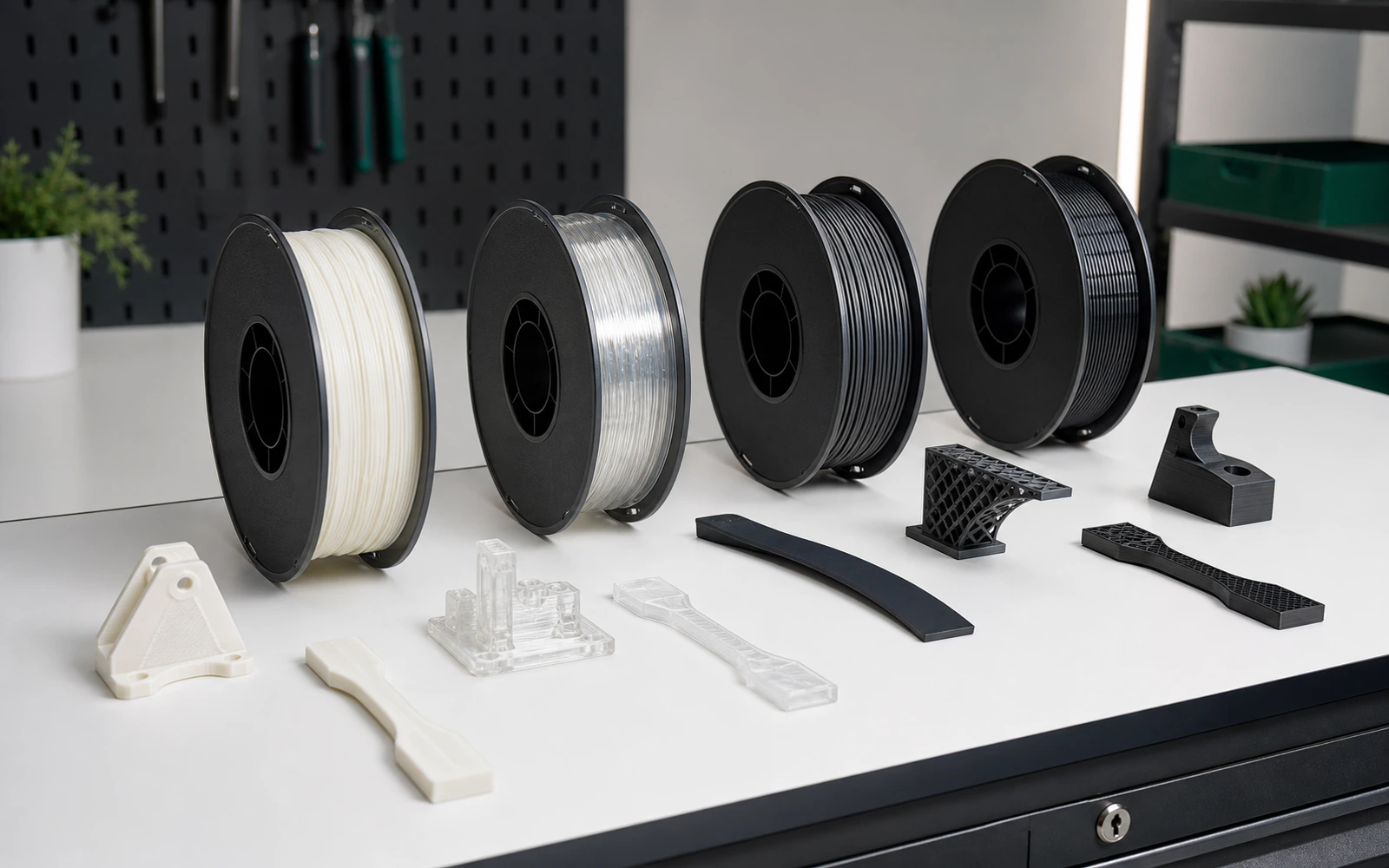
Work backward from the part, printer, finish, and approval test to prepare a defensible filament shortlist for samples or quotation.
- Part geometry, wall thickness, load direction, and expected service life
- Critical fit, surface, handling, and appearance requirements
- The printed test, measurement, or user review that determines approval
- Indoor or outdoor exposure and expected duration
- Temperature cycles, sunlight, moisture, chemicals, oils, cleaners, or skin contact
Use this outline to make a supplier conversation specific. Keep fixed requirements separate from open questions, and treat the selected grade, documents, sample route, commercial scope, and release record as written project confirmations.
Start with the part, not the resin name
Write down what the finished part must do, where it will be used, and how approval will be decided. Separate a hard requirement from a preference before comparing material families.
Put these details in the brief
- Part geometry, wall thickness, load direction, and expected service life
- Critical fit, surface, handling, and appearance requirements
- The printed test, measurement, or user review that determines approval
Describe the actual service environment
Indoor, outdoor, vehicle, factory, food-contact-adjacent, medical-adjacent, and educational settings create different review questions. State the real environment without implying a compliance status that has not been verified.
Put these details in the brief
- Indoor or outdoor exposure and expected duration
- Temperature cycles, sunlight, moisture, chemicals, oils, cleaners, or skin contact
- Destination market and any restricted-use or documentation question
Translate mechanical needs into a testable brief
Terms such as strong, tough, rigid, or flexible are not purchasing specifications. Connect the required behavior to the part geometry, print direction, conditioning, and approval method.
Put these details in the brief
- Load type, direction, duration, and acceptable deformation
- Impact, fatigue, wear, friction, or repeated-flex requirement
- Representative printed test and acceptance owner
Separate print temperature from service-temperature needs
A material's printing window does not prove that a finished part is suitable for a hot application. Treat service-temperature performance as a separate grade and application qualification question.
Put these details in the brief
- Continuous and short-duration service conditions
- Heat source, ventilation, load, and dimensional-stability expectation
- Grade-specific document or printed-part test required for approval
Record moisture, chemical, and cleaning exposure
Humidity during storage, water in service, cleaning chemicals, oils, and process fluids can affect material choice and handling. Name the substance, concentration, temperature, contact time, and test route where relevant.
Put these details in the brief
- Storage humidity and drying or resealing requirement
- Water, oil, cleaner, solvent, or other chemical exposure
- Appearance, dimensions, strength, or mass change used to judge the result
Treat UV and outdoor use as a separate qualification
Outdoor suitability depends on the exact grade, color, exposure, geometry, duration, and acceptance criterion. Do not apply a family-level marketing phrase to every formulation.
Put these details in the brief
- Sunlight, weather, temperature cycle, and installation orientation
- Color shift, cracking, dimensional change, or mechanical retention question
- Outdoor sample, document, or accelerated test required by the buyer
Define surface, color, and visual expectations
Matte, silk, sparkle, marble, wood, translucent, or high-gloss effects need a physical sample under intended lighting. Record whether layer visibility, color direction, seam placement, and post-processing matter.
Put these details in the brief
- Physical color or effect reference and acceptable viewing light
- Surface texture, gloss, transparency, and layer-line expectation
- Representative curved and flat sample geometry
Name the dimensional and fit requirements
Dimensional performance depends on geometry, orientation, profile, cooling, environment, and measurement method. Use the buyer's actual fit and measurement plan rather than a generic accuracy claim.
Put these details in the brief
- Critical dimensions, datums, tolerances, and measurement equipment
- Print orientation, support, post-processing, and conditioning state
- Mating part or gauge used for approval
Record printer and process constraints
A technically attractive polymer may still be a poor starting point for the available printer fleet. Capture practical limits before samples are selected.
Put these details in the brief
- Printer models, feeder route, enclosure, and build surface
- Hot-end range, nozzle size, and available process controls
- Operator skill, throughput target, and profile-management route
Check abrasion and nozzle compatibility
Fiber-reinforced, glow, metal-filled, wood-filled, and other additive-containing filaments may create different feed and wear questions. Confirm the exact grade and equipment path before committing to a production range.
Put these details in the brief
- Nozzle material, diameter, wear allowance, and replacement plan
- Feeder, tube, sensor, and hot-end path
- Printed quality check after the intended production run length
Confirm enclosure, ventilation, and workplace controls
Printer enclosure, chamber behavior, ventilation, filtration, and local workplace requirements can limit a material choice. Record the equipment and operating policy used for qualification.
Put these details in the brief
- Open, enclosed, or heated-chamber printer route
- Ventilation, filtration, monitoring, and operator-access requirements
- Applicable SDS and workplace review owner
Plan drying, storage, and opened-spool handling
Moisture-sensitive materials need a documented handling route from receipt through printing and resealing. Avoid treating one generic drying value as proof for every grade.
Put these details in the brief
- Supplier or grade-specific preparation guidance requested
- Dryer equipment, logging, transfer, and opened-spool exposure
- Reseal, desiccant, storage, and requalification trigger
Verify spool, feeder, and material-delivery fit
Diameter and net weight do not fully describe spool compatibility. Record flange, hub, width, winding, mounting, feeder, and material-handling constraints for the buyer's equipment.
Put these details in the brief
- Spool dimensions, net weight, hub, and mounting route
- External feeder, dryer, multi-material system, or production rack
- Winding, tangling, changeover, and remaining-material controls
Use material families to narrow the decision, not finish it
PLA, PETG, ABS, ASA, TPU, PC, PA, PET, PPS, and blended or modified families provide useful starting categories. The published family name does not replace exact-grade qualification.
Put these details in the brief
- Why the family is on the shortlist
- Which grade-level property or document is still required
- Which alternative family remains as the fallback
Compare reinforced and unfilled grades deliberately
Carbon- or glass-fiber reinforcement can change stiffness, surface, wear, anisotropy, printer requirements, and cost. Compare the exact reinforced grade against the unfilled alternative on the intended part.
Put these details in the brief
- Stiffness, dimensional, weight, and surface objective
- Abrasion, nozzle, enclosure, and handling implications
- Layer-direction and failure-mode review on the representative geometry
Qualify translucent and special-effect materials visually
Color-changing, glow, silk, sparkle, marble, wood, metal-like, gradient, and translucent effects vary with wall thickness, lighting, orientation, lot, and geometry. Approve a physical reference instead of relying on a screen image.
Put these details in the brief
- Flat, curved, thin-wall, and thick-wall reference pieces
- Lighting, viewing distance, orientation, and color-transition expectation
- Accepted sample retained for repeat-order comparison
Design a sample plan around the decision
A useful sample should expose the buyer's most important risk. Define the printer, profile starting point, geometry, quantity, conditioning, owner, and pass/fail observations before samples are requested.
Put these details in the brief
- Exact grade, color, diameter, spool, and sample quantity
- Representative printer, profile version, and build orientation
- Reviewer, target date, measurements, observations, and disposition
Request grade- and market-specific documents
Ask for technical, safety, compliance, or declaration documents that apply to the selected grade and destination market. Check the title, version, date, issuer, scope, and replacement requirement.
Put these details in the brief
- TDS, SDS, and applicable compliance-document request
- Exact grade and market coverage
- Document owner, review date, and version retained with the decision
Connect the shortlist to supply and commercial constraints
Availability, color method, minimum quantity, sample timing, lead time, spool and pack configuration, private label, destination, and replenishment can change the practical choice. Keep commercial questions beside the technical shortlist.
Put these details in the brief
- Opening quantity, monthly demand, target date, and destination
- Color, spool, packaging, private-label, and document scope
- Alternative configuration if the preferred route is not feasible
Approve a narrow shortlist and preserve the repeat-order record
Keep the final shortlist small enough to test and compare. When a grade is approved, retain the exact material, color reference, printer/profile, spool and pack configuration, documents, sample result, and decision date.
Put these details in the brief
- Candidate grade and known trade-offs
- Approved sample, profile, documents, and commercial reference
- Change-control trigger and identifier used for repeat purchasing
Record the owner, accepted reference, open question, and decision date for each item that changes qualification or repeat ordering.
Browse more resources Private-label checklist
Define one sellable SKU before artwork
Novtau technical team · 8 min read
 Quality and release brief
Write the checks and records into the order
Novtau technical team · 8 min read
 Program examples
Review filament program patterns
Novtau technical team · Planning library