

Custom Colors & Private Label
Match any color and launch it under your own brand, with proofs before printing.
Explore custom colorsYour own brand from 500 spools, colors combined — explore private label.

STANDARD FILAMENTS
ENGINEERING
BRANDS & RESELLERS
FUNCTIONAL PARTS
HOME & GIFTS
Match any color and launch it under your own brand, with proofs before printing.
Explore custom colors
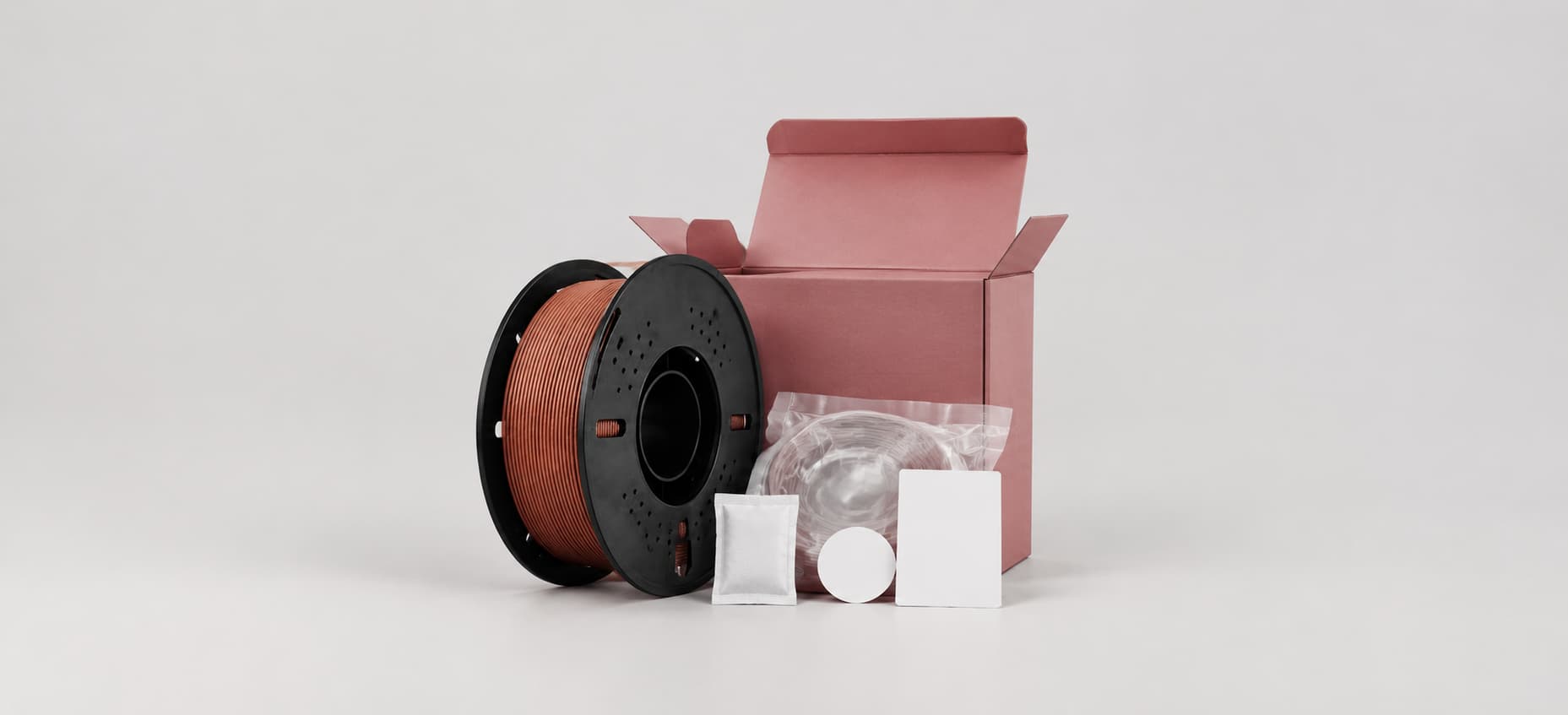
Custom spools, labels and printed boxes, made and packed by us.
Explore packaging
Color cards, stock spools and your own private-label sample before you order.
Explore samplesFor parts that sit in the sun, choose ASA. For parts that see heat but stay indoors, ABS is the classic choice. PETG is the easiest of the three to print and handles water and moderate warmth well, but it is not the best pick for long sun exposure or high heat.

Ask two questions about the part. Will it live in sunlight? Will it get hot? If it lives outside, print it in ASA. If it gets hot but stays indoors, print it in ABS or ASA. If it does neither but needs to be tougher than PLA, print it in PETG. That covers most real decisions.
Sunlight breaks down many plastics over time. The surface fades, turns chalky and gets brittle. ABS is particularly sensitive: a black ABS part left outside will gray and weaken over a season or two.
ASA was developed for this problem. It prints and behaves much like ABS, but it is far more resistant to UV light, which is why car exterior trim, garden fittings and outdoor housings are made from it. If a part will be in direct sun, ASA is the safe choice, and the color you print is the color it stays.
PETG sits between the two. It handles outdoor use better than ABS and is fine for parts in partial shade or for a single season, but for long, direct exposure, ASA is the better material.
All three are far more heat resistant than PLA, which softens in a hot car. But they are not equal. ABS and ASA hold their shape at higher temperatures than PETG. For a part inside a car in summer, near a motor or next to a warm electronic component, choose ABS or ASA.
PETG is fine for warm environments, such as a part in a room that gets sun through the window or a housing for low-power electronics. If the part will see real heat for long periods, move up to ABS or ASA.
PETG prints on almost any printer without an enclosure. It bonds well between layers, rarely warps and gives strong parts with standard settings. Its main habit is stringing, which you control by drying the spool and lowering the temperature a few degrees.
ABS and ASA need more care. Both shrink as they cool, so large parts can warp and tall parts can split between layers if the room is cold or drafty. An enclosed printer solves most of this. Both also give off a noticeable smell while printing, so print them in a ventilated space.
ASA is generally a little more forgiving than ABS on warping, which is one more reason many print farms now default to ASA for functional parts.
Typical temperatures for all three are in our Filament Print Settings Chart.
ABS is the easiest to finish. It sands well, takes paint, and can be smoothed to a glossy surface with acetone vapor. That is why it is still popular for display models and parts that need a clean surface.
ASA sands and paints in much the same way. PETG is harder to sand cleanly and does not smooth with acetone, so it is less suited to parts that need a polished finish.
PETG is the strongest of the three around water and many household chemicals, which makes it a good choice for parts in kitchens, bathrooms, planters and anything that gets washed. ABS and ASA handle water well too, but PETG is the usual first choice for wet, indoor use.
| The part will… | Choose |
|---|---|
| Live outdoors in direct sun | ASA |
| See real heat, indoors | ABS or ASA |
| Be handled, washed or get wet, indoors | PETG |
| Need a smooth, glossy finish | ABS |
| Be printed on an open-frame printer | PETG |
| Need extra stiffness outdoors | ASA-CF |
If your customers are mostly hobbyists on open-frame printers, PETG will outsell ABS and ASA. Stock it in core colors and keep ABS and ASA in black, white and gray.
If you sell to print farms, makers of outdoor products or automotive hobbyists, ASA is worth carrying in a wider range. It is the material those customers ask for once they have had a PETG or ABS part fade.
Stock orders with us start at 100 spools, and you can mix PETG, ABS and ASA in the same order. Ask us for samples of all three to test on your customers' printers.
Is ASA just better ABS?
For outdoor use, yes. For indoor parts that need acetone smoothing or the lowest cost, ABS is still a good choice.
Can I print ABS or ASA without an enclosure?
Small parts, sometimes. Larger parts warp or crack without one. If you do not have an enclosure, use PETG.
Is PETG good outdoors?
For partial shade or short-term use, yes. For years of direct sun, choose ASA.
Which is strongest?
All three make strong parts. PETG has the best layer bonding on open printers. ABS and ASA hold up better at higher temperatures.
New colors, printing tips and buying guides, about once a month.